


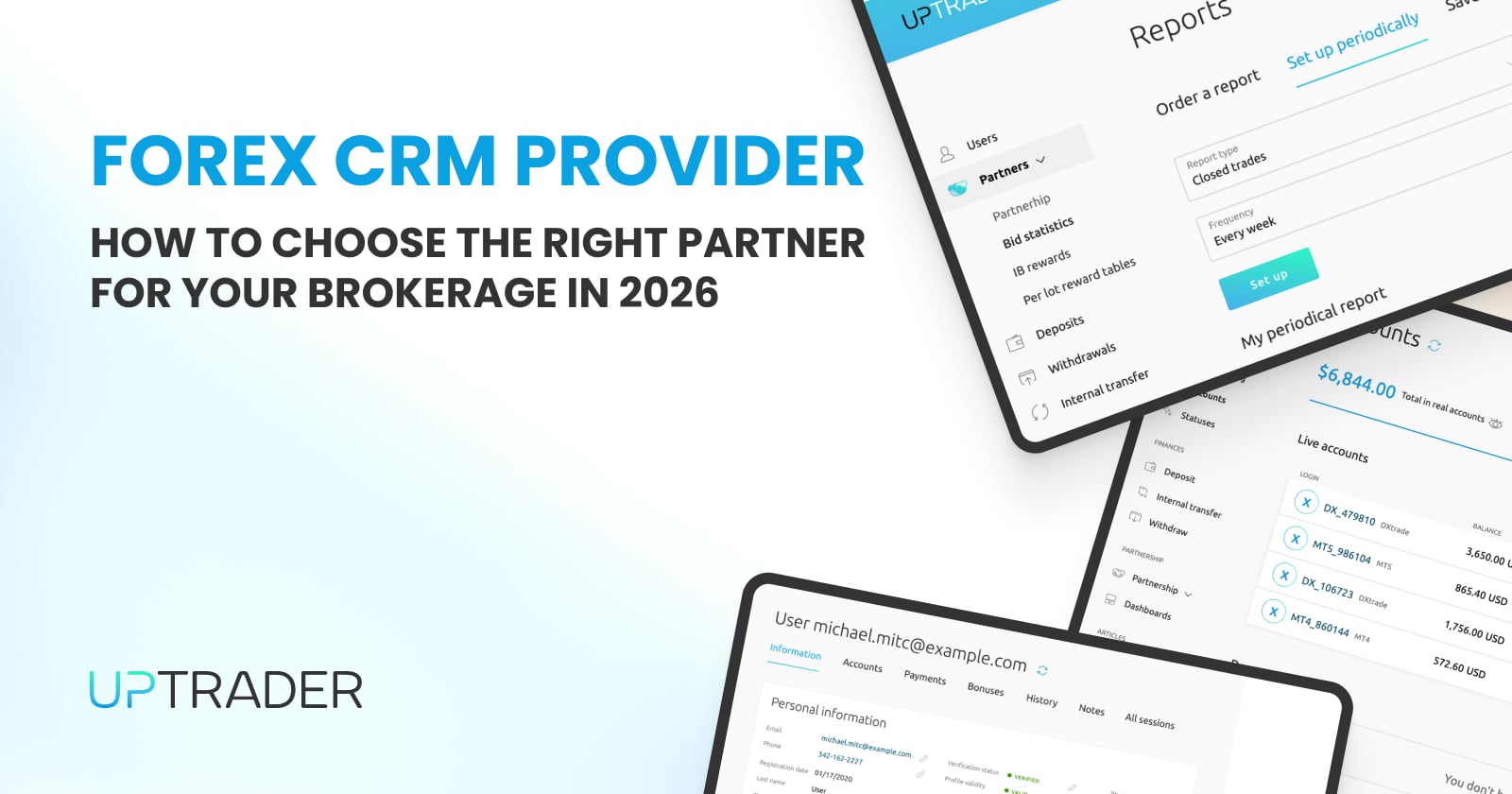
Forex CRM Provider: How to Choose the Right Partner for Your Brokerage in 2026
Share this publication:
When you choose a Forex CRM, you are not just purchasing software. You are entering a vendor relationship that will shape how your brokerage operates for years. The platform's features matter, but equally consequential is the organization standing behind that platform: their implementation process, their support infrastructure, their development roadmap, their security posture, and their willingness to solve problems that surface relentlessly in production but never appear in a demo.
Most Forex CRM evaluation content focuses exclusively on the product. Feature comparisons, integration checklists, pricing tables. Those are useful inputs, but they are incomplete. The brokerages that end up migrating away from a Forex CRM within 18 months rarely leave because the software lacked a feature. They leave because the provider could not deliver adequate support during a critical compliance deadline, because the implementation took four months instead of the promised four weeks, or because the development roadmap pivoted away from the capabilities the brokerage needed most.
This guide focuses on the provider side of the decision: what to evaluate about the company behind the Forex CRM before you commit to a partnership your entire operation will depend on.
Forex CRM Provider Industry Specialization Is Non-Negotiable
The Forex CRM market, valued at over $530 million in 2025 and projected to reach $950 million by 2033, has attracted providers from outside the industry who see an opportunity but lack the operational understanding to deliver a product that works under brokerage conditions. A provider that built its platform for SaaS companies or general financial services and then added a Trading Platform integration does not understand the workflows that define your daily operations.
You need a provider that has built for regulated brokerages specifically. That means they understand KYC and AML workflow requirements across different jurisdictions. They understand multi-currency wallet architecture and why single-wallet ledger design matters for reconciliation. They understand the complexity of multi-tier IB commission computation and why it cannot be handled through a generic rebate module.
When evaluating a provider, ask how many active brokerage clients they serve. Ask for reference clients in your specific regulatory jurisdiction. A provider that cannot produce a reference in your jurisdiction has not been tested under the regulatory conditions you will face. That is a red flag worth taking seriously.
Forex CRM Implementation: The First Test of the Relationship
The implementation process is the earliest and most revealing indicator of what your long-term relationship with a Forex CRM provider will look like. How they handle setup, configuration, and go-live support tells you everything about how they will handle problems once you are operational.
Well-established providers with mature deployment processes can typically configure a standard setup within one to two business days. More complex implementations involving multi-jurisdiction compliance, extensive PSP integrations, and multi-server trading platform connectivity will take longer, but the provider should give you a clear timeline with defined milestones before the project begins.
Evaluate the quality of onboarding support. Does the provider assign a dedicated implementation manager, or are you routed through a generic support queue? Do they conduct a workflow mapping session before configuration, or do they apply a default setup and leave customization to you? A provider that rushes through implementation to report fast deployment times may leave you with a system that technically works but is not configured for how your brokerage actually operates.
Support Forex CRM Quality After Go-Live
Support during implementation is expected. What separates strong providers from weak ones is what happens after you go live, when the initial attention fades and you are running the platform in production.
Your brokerage does not operate on a nine-to-five schedule. Markets run around the clock, and operational issues do not wait for business hours. Evaluate whether the provider offers around-the-clock support for critical issues or whether you are limited to regional hours with a ticketing system that responds within 24 to 48 hours.
Ask how the provider handles escalation. When your compliance team encounters a workflow issue during a busy onboarding period, do they have a direct line to a product specialist, or do they submit a ticket and wait? The providers who have been in the Forex CRM space for a decade or more have encountered and resolved the edge cases that newer vendors have not yet faced. That experience translates directly into faster incident resolution and fewer situations where support needs to escalate internally before they can help you.
Security and Compliance Posture
Your Forex CRM holds sensitive client data: personal identification documents, financial records, trading activity, and communication logs. The provider's security infrastructure is not a secondary consideration. It is a regulatory requirement.
Seek out service providers who have internationally certified security credentials. International Standard ISO 27001 (ISO 27001) is regarded as the standard for ISMS certification throughout the globe because it requires an annually independent verification of their organization's information security processes. In addition to certification, look at these areas; examine the role based access controls; encryption of data; data residency options and incident responses plans. If you do business in multiple locations, you should know where your customer data will reside as well as whether your service provider offers a region based data residency option to ensure compliance with the local data protection legislation.
Ecosystem Dependency and Forex CRM Vendor Lock-In
Some Forex CRM (customer relationship management) vendors are part of a larger technology ecosystem, providing their customers with a complete set of solutions that include liquidity, payment processing and trading platforms along with CRM functionality. The connectivity between services is often very good due to being integrated within an ecosystem. The downside is you can also become over reliant on the Forex CRM vendor. Your organisation could find itself in a situation where you're tied to a CRM vendor if the vendor's products cannot operate successfully with other vendors in the ecosystem.
Determine whether your Forex CRM will work seamlessly with third party trading platforms, payment service providers (PSP's) or compliance products or whether you must remain within your service provider's "closed stack" to get optimal performance. A provider that builds an open platform with documented APIs and broad third-party support gives you more operational flexibility.
The cost of leaving a vendor is also worth evaluating upfront. Migration typically costs between $20,000 and $80,000 when you account for data export, integration rebuilding, team retraining, and operational disruption over a three-to-six-month transition period. Understanding the exit cost before you enter the relationship ensures you are committing with full awareness.
Forex CRM Development Roadmap and Product Direction
The Forex CRM you deploy today will need to evolve alongside your brokerage. New trading platforms, new regulatory requirements, new payment methods, new product lines like prop trading. Your Forex CRM provider needs to support those developments through ongoing product updates.
Ask about their development roadmap. How frequently do they release updates? How do they prioritize feature requests from existing clients? Do they have a track record of adding support for emerging industry needs such as prop trading modules, AI-driven lead scoring, or multi-asset account management? A provider whose product has remained largely unchanged for two or three years is a provider whose platform will increasingly fall behind the demands of a modern brokerage.
Conclusion
The right Forex CRM provider is not the one with the longest feature list or the most aggressive pricing. It is the one that demonstrates industry-specific expertise, delivers a transparent implementation process, provides reliable support after go-live, maintains strong security standards, offers integration flexibility without ecosystem lock-in, and invests continuously in product development.
You are choosing a technology partner, not a software subscription. Evaluate the provider with the same diligence you would apply to any long-term business relationship.
UpTrader is a purpose-built forex CRM provider offering integrated back office, trader room, and investment module infrastructure with native Trading Platform 4/5, cTrader, and DXtrade support.
Request a tailored demo and evaluate your partnership here.